
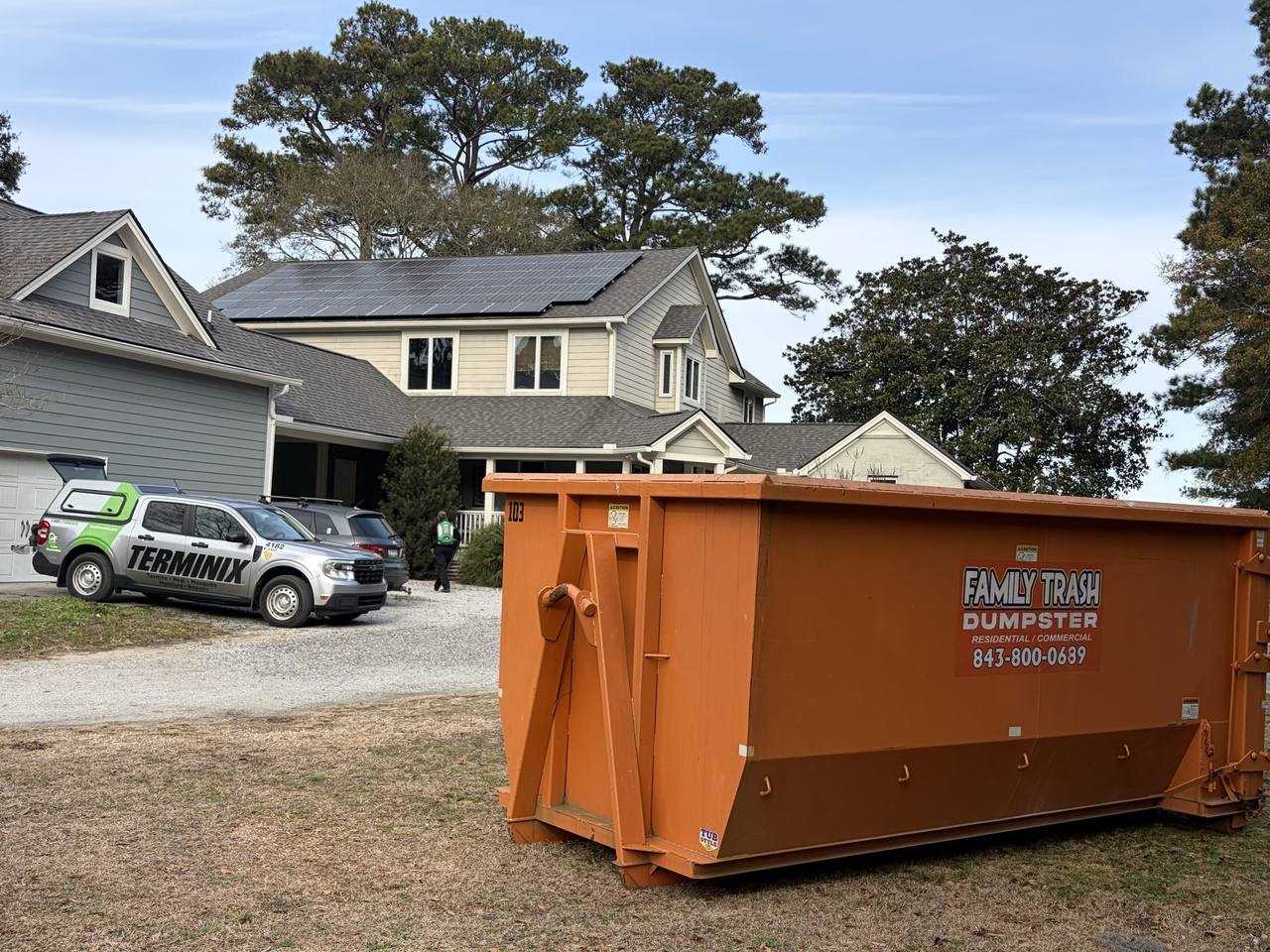
A remodel or a tear-out throws off a strange mix of material. Heavy stuff like old brick and concrete, lighter stuff like drywall and framing scrap, plus a pile of odd-shaped offcuts that never stack the way you want. How you load the dumpster matters more than most people think. Pack it wrong and you waste space, overload the box, or end up with material we cannot legally haul. Here is how we tell Charleston homeowners and contractors to do it.
Match the material to the right box first
This is the part people get backward. With us, the 7-yard is the only size built for heavy, dense material. Concrete, dirt, rock, brick, sod, and roofing shingles all go in the 7-yard and nowhere else. It is a smaller box on purpose. A pile of concrete gets heavy fast, and a bigger box full of it can't be safely lifted onto the truck.
If your debris is the lighter remodel kind, framing lumber, drywall, trim, cabinets, subfloor, and general construction scrap, that goes in a 13, 17, or 22-yard box. Those sizes take the bulky stuff but no heavy material. You can't mix a layer of broken concrete into a 17-yard full of drywall. If a job has both, you rent two boxes or swap one out. When you're not sure which way a load leans, look over all our dumpster sizes or just call and describe the project.
Load heavy material flat and low
For a 7-yard heavy load, lay material across the floor of the box instead of dumping it in one corner. Spread broken concrete, brick, and block evenly so the weight sits balanced. Keep it below the top rail. A heavy box filled past the line can't be hauled, and you'll be moving material back out by hand before we can take it.
Clean heavy loads matter too. If your concrete or brick is free of trash, wood, and dirt, it goes to the recycle plant instead of the landfill. So keep the heavy box heavy-material-only. Don't toss a coffee cup or a chunk of plywood in there.
Break down and stack the bulky stuff
For the bigger boxes, the goal is to use the air. A 17-yard fills up fast if you throw long boards in whole and let them bridge across the box. Cut down long lumber, snap apart pallets, and collapse cabinet boxes flat. Drywall lies flat and stacks well. Knock down anything hollow so it nests instead of trapping empty space.
Load the flat and heavy-for-its-size pieces first, along the bottom. Then fill the gaps with the awkward offcuts and loose scrap. Save the light bulky stuff, insulation, trim, and broken pieces, for the top. Working in rough layers gets you a lot more debris in the same box than a random pile does.
Keep out what we can't take
A construction job almost always generates a few things that don't belong in any dumpster. We can't take batteries, chemicals, or electronics. That covers paint, solvents, adhesives in liquid form, old smoke detectors, and any battery backup or power tool pack you find behind a wall. Set those aside as you go so they don't get buried in the load.
It's worth a two-minute read through what goes in a dumpster before you start. Catching a problem item on day one is easy. Digging it back out of a packed box on pickup day is not.
Plan for the load, not just the dumpster
Think about where the box sits before it shows up. A driveway close to the work saves you a hundred trips with a wheelbarrow. Leave room to walk around it so you can load from more than one side and balance the weight. If you're working off a roof or a second floor, position the box where you can drop or chute material down without it landing in the street.
On bigger jobs, rentals run 1 to 30 days, and we can swap a full box for an empty one so the work doesn't stall. That's the usual move on a gut remodel or a full re-roof. Fill the heavy box, we pull it, you keep going.
We're family-owned, based on James Island, and we run dumpsters across Charleston and the towns we serve. If you're staring at a project and aren't sure whether you need one box or two, or which size fits the material, call or text (843) 800-0689 and describe what you're tearing out. Tony answers his own phone, and it's a quick conversation.
Need a dumpster in Charleston? Call or text Tony at (843) 800-0689, or order online.
(843) 800-0689 Get instant pricing