
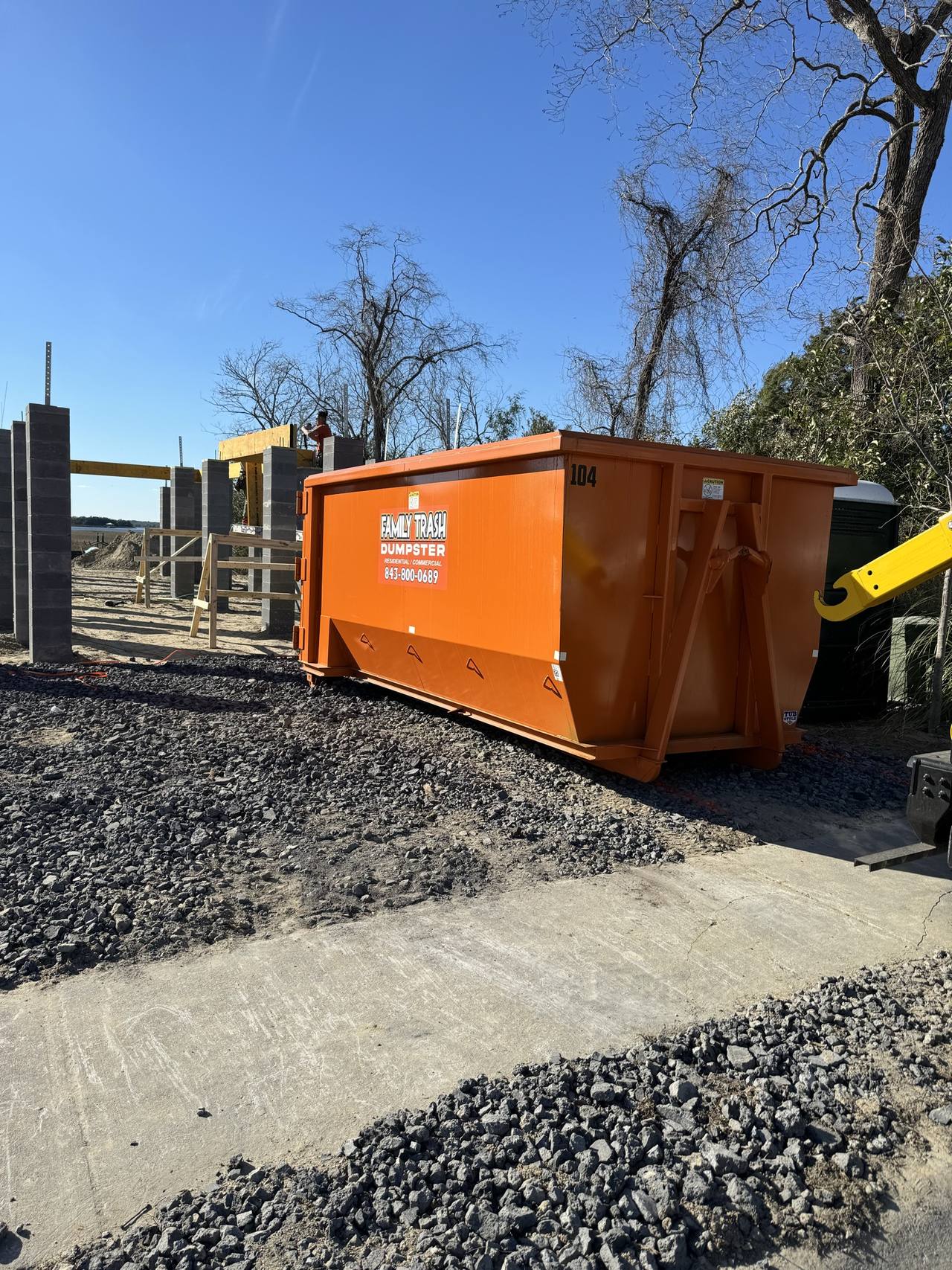
Summer break is when most Charleston schools finally get to clear out the stuff that piled up all year. Old classroom furniture, broken playground pieces, stacks of outdated textbooks, busted lockers, the random junk that lives in the back of the gym storage room. If you're an administrator staring down a building emptying out for the season, a roll-off dumpster on site usually beats running a dozen pickup trucks to the county landfill. Here's how to think it through.
Match the dumpster to what you're tossing
The first question isn't how much you have. It's what kind of material it is, because that changes the size you should order.
Most campus cleanouts are light, bulky stuff. Desks, chairs, shelving, cardboard, carpet, paper, drywall from a small renovation, wood from a shop class. For that, our 13, 17, and 22-yard cans are the right call. They give you the volume to handle a full classroom or a wing without overpaying for a smaller one you'll fill in a day. If you're clearing a single room or a small storage area, the 13-yard handles it without taking up half the parking lot.
The exception is heavy, dense material. If your project involves concrete from an old walkway, brick from a wall, dirt and sod from a field regrade, or roofing shingles off a maintenance shed, that goes in the 7-yard and only the 7-yard. Heavy material gets weight-restricted to that size on purpose, and clean heavy loads head to the recycle plant. Don't try to put broken concrete in a 22-yard. It can't take it.
If you're not sure which bucket your debris falls into, look at all our dumpster sizes or just call and describe the job. That's faster than guessing.
Watch what can't go in
Schools generate a few things a dumpster can't legally hold, and it's worth flagging these to your custodial staff before the can shows up. We can't take batteries, chemicals, or electronics. That means the old emergency-light batteries, the cleaning-supply drums in the boiler room, and the dead computers from the lab all need a different path. Lab chemicals especially have their own disposal rules in South Carolina, so route those through your district's hazardous-waste process.
For everything else, the list of what goes in a dumpster covers the typical campus haul. When in doubt, ask before you load it.
Plan placement and access
A school site has more moving parts than a driveway. Before delivery, figure out where the can goes. You want it close to the building you're clearing but out of fire lanes, bus loops, and any spot that blocks an exit. A flat, hard surface like asphalt or concrete is ideal so the truck has clean access for drop-off and pickup.
Think about timing too. A campus is easiest to work around when students are gone, so the first weeks of summer are usually the sweet spot. If you're doing the cleanup over a holiday break or a long weekend while school's in session, plan the drop and pickup around bus schedules and dismissal so nobody's working around a truck during pickup or drop-off.
Use the rental window to your advantage
Rentals run anywhere from 1 to 30 days, which works well for the way school projects actually go. Some cleanouts are a single Saturday with a crew of staff and volunteers. Others stretch across weeks as one department clears out, then the next. Pick a window that matches your pace instead of rushing to fill it.
On bigger jobs, we can swap out a full can for an empty one so the work doesn't stop. That's common when a school is doing a real overhaul, like gutting a wing for renovation or clearing a whole building before new flooring goes in. You keep loading, we keep hauling. Delivery, pickup, and disposal are all part of the rental, so you're not coordinating a separate trip to the dump.
Working with a local company
We're family-owned, based on James Island, and we cover Charleston plus the surrounding towns. If your school sits in one of the towns we serve, we can get a can to you. Tony answers his own phone, seven days a week, so when you're trying to lock in a delivery date around your custodial schedule, you're talking to the person who actually runs the route, not a call center.
If you're mapping out a summer cleanup and want to figure out the right size and timing, call or text (843) 800-0689. Tell us what you're clearing and where the building is, and we'll point you to the can that fits the job.
Need a dumpster in Charleston? Call or text Tony at (843) 800-0689, or order online.
(843) 800-0689 Get instant pricing