
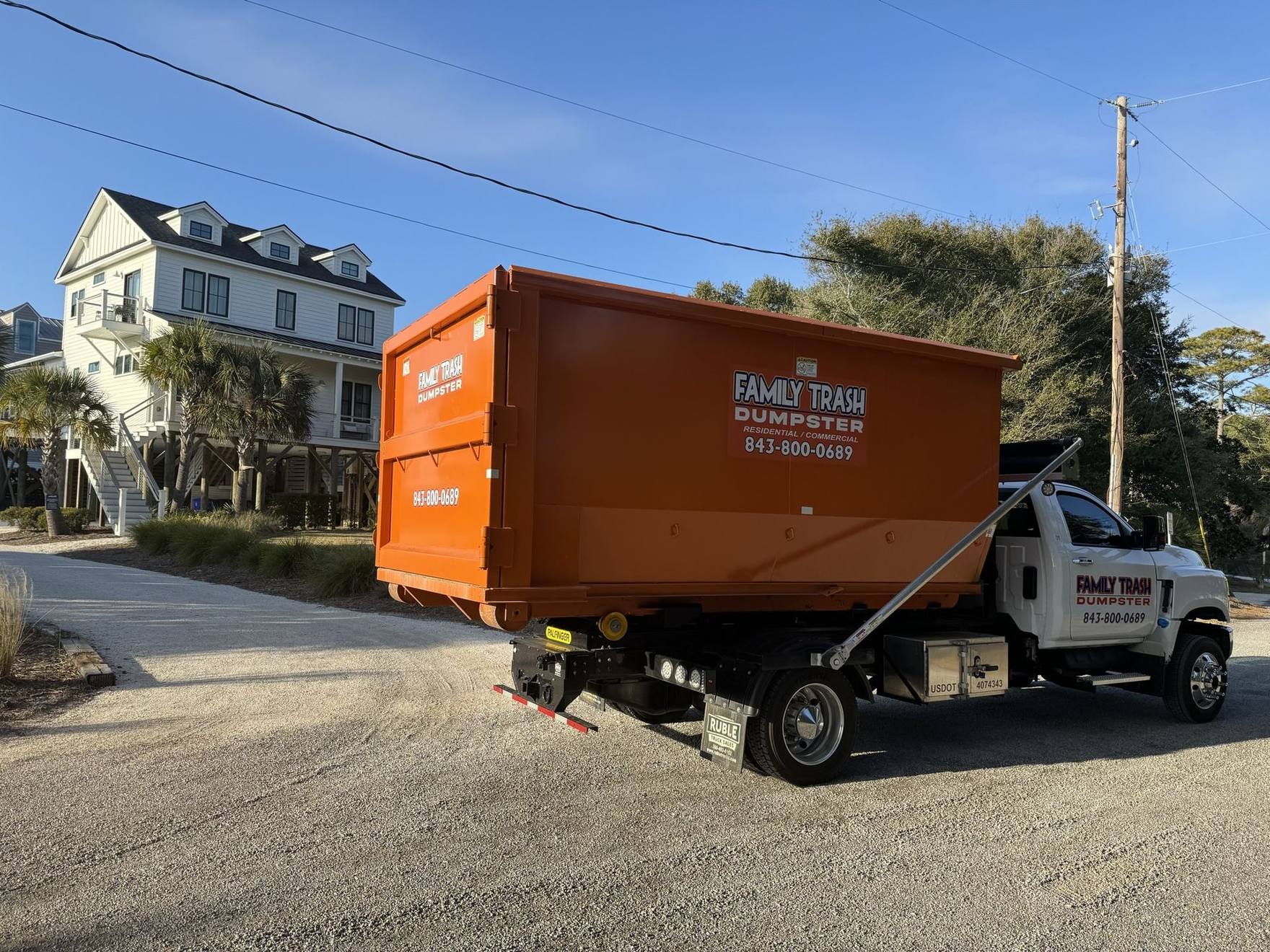
Some home projects make a little trash. Others fill your garage with debris faster than the county will ever haul it away. If you're standing in your yard looking at a pile that's growing every weekend, a roll-off dumpster sitting in the driveway usually solves the problem cheaper and faster than running loads to the dump in your truck. Here are five jobs around Charleston where renting one actually makes sense, and the size that tends to fit each.
1. Garage, attic, or whole-house cleanout
This is the most common reason people call. You're emptying a parent's house, clearing years of boxes out of the attic, or finally dealing with the garage you can't park in. The waste here is mostly household stuff, old furniture, broken cans, and the random junk that piles up over a decade.
For a single garage or one heavy room, the 7-yard is often enough and sits in a tight driveway without taking the whole thing. For a full house worth of belongings, step up to a 13 or 17 yard. None of these sizes take batteries, chemicals, or electronics, so set those aside for proper drop-off. If you're not sure where a specific item lands, here's what goes in a dumpster.
2. Bathroom or kitchen remodel
Remodels generate more debris than people expect. Tile, cabinets, countertops, old fixtures, drywall, and packaging from everything new adds up quick. The trouble with a remodel is that the debris comes out in waves over a week or two, so you want a container on site the whole time instead of bagging things and tripping over them.
A 13 or 17 yard handles most single-room remodels. If you're gutting a kitchen down to the studs, the larger size gives you room for cabinets and bulky boxes. One thing to know about tile and old mortar: if you're tearing out a lot of dense tile or concrete backer, that material is heavy. Heavy, dense loads go in the 7-yard, which is the only size built for that weight. Keep the light remodel debris in the bigger can and the dense stuff separate.
3. Roof replacement
Shingles are deceptively heavy. A single layer of tear-off from an average roof can weigh more than most people guess, and a second or third layer multiplies it. That weight is exactly why roofing has its own rule here. Shingles, like concrete and brick, go in the 7-yard. It's the size we run for dense material, and the load heads to the recycle plant when it's clean.
If you're a contractor doing the roof yourself or a homeowner who hired one, put the dumpster where the crew can pitch debris straight in. On bigger tear-offs we can swap a full can for an empty one so the work doesn't stop while it's hauled off.
4. Yard overhaul and storm cleanup
Charleston yards produce a lot of green waste. Clearing overgrown beds, taking down a few trees, or cleaning up after a storm leaves brush, branches, and old fencing that won't fit in your county cart. Yard brush, wood, and general debris go in the standard sizes, so a 13 or 17 yard works for most cleanups.
Watch out for one thing: dirt, sod, and rock are heavy material. If your yard project includes digging out a bed and hauling away the soil, that dirt belongs in the 7-yard, not the big can. Mixing heavy dirt into a large dumpster makes it too heavy to safely haul. When in doubt, keep the heavy stuff in its own container.
5. Moving out or downsizing
Moving is when you find out how much you've been holding onto. Between the stuff that won't make the trip and the broken furniture you meant to toss years ago, a dumpster in the driveway during your last week is a relief. You load it on your own schedule and we haul it when you're done.
For a downsizing move, a 7 or 13 yard usually covers it, depending on how much furniture is going. If you're also moving equipment or materials and need something flat to load, we run a 14-foot flatbed for that. You can see the full lineup on all our dumpster sizes.
Picking your size without overthinking it
The short version: light, bulky stuff like furniture, household junk, wood, drywall, and brush goes in the 13, 17, or 22 yard. Heavy, dense material like concrete, dirt, rock, brick, sod, and roofing goes in the 7-yard. If a job mixes both, keep them in separate cans so nothing gets too heavy to move.
We're based on James Island and cover Charleston and the towns around it. If you want to see whether your address is in range, check the towns we serve. And if you'd rather just describe your project and let someone tell you which can to drop, call or text (843) 800-0689. Tony usually answers, seven days a week, and can sort out the right size in a couple of minutes.
Need a dumpster in Charleston? Call or text Tony at (843) 800-0689, or order online.
(843) 800-0689 Get instant pricing