
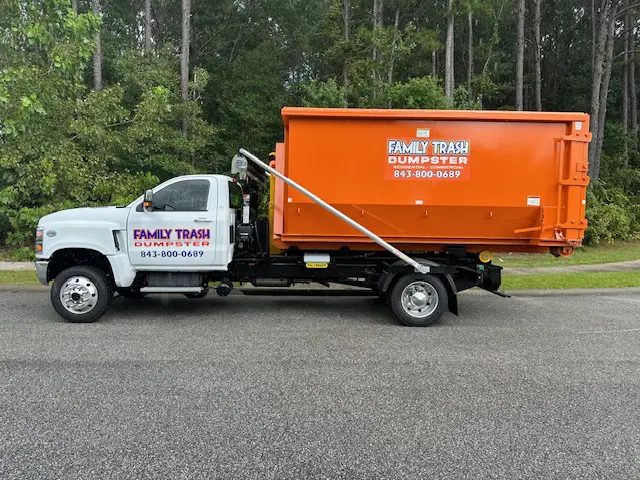
A jobsite makes debris faster than anything, and the crews that run smooth are the ones that planned where it all goes. That's why most Charleston builders keep a roll-off on site instead of hauling loads themselves. It keeps the site clean, keeps the crew working, and keeps the trips to the dump off your schedule.
Here's what contractors actually get out of it.
The right size for the phase
A demo phase throws off different debris than a finish phase, so the size that fits changes as the job moves. The 17-yard handles a solid day of mixed construction debris, and the 22-yard is our largest for the heavy stretches. It still fits the tight Charleston lots where a 30 won't, which matters more downtown than anywhere.
On a longer job it's worth thinking about it in stages. Demo generates the most volume in the shortest window. Rough-in is steadier and lighter. Finish work is mostly packaging, offcuts, and trash, which is often a smaller can than crews expect. Matching the size to the phase beats leaving one big container sitting half empty for three weeks.
Keep the heavy material separate
Heavy, dense material is the exception to everything above. Concrete, dirt, brick, and roofing tear-off go in the 7-yard, since that's the can rated for the weight, and a clean load goes to the recycle plant instead of the landfill.
That last part is worth planning around. A 7-yard with nothing but clean concrete and dirt in it gets recycled. Let the crew toss lumber and wrappers into the same can and it all goes to the landfill instead. On a big project it's common to run a 22 for the bulk debris and a 7 for the heavy stuff, and to tell the crew plainly which one is which.
Swap-outs keep the crew moving
The worst time to run out of dumpster is mid-pour or mid-tear-off. If you fill up before the job's done, call and we'll swap the full can for an empty one. You don't lose a day waiting, and you don't have a pile growing next to the container.
If you know the schedule ahead of time, tell us. Builders who flag the demo week in advance get a smoother rotation than the ones who call the morning the can fills up.
Where the can sits matters
Placement is worth five minutes at the start of the job. The can needs to be somewhere the crew will actually walk to, close to where the debris is coming from, without blocking the drive the trades and deliveries need. A container that's inconvenient turns into a pile beside the container.
Think about the truck too, not just the can. There has to be room to back in and clearance overhead to lift it. Soft ground, fresh landscaping, and low limbs all decide where a loaded truck can safely go. Tell us what the site looks like and we'll work it out before the drop rather than after.
Street placement and permits
A driveway or the lot itself is easiest and doesn't require a permit. Putting a can on a public street is a different conversation, and the city sometimes wants a permit for it, especially downtown and in the historic district. If your site doesn't have room on private property, sort that out early. Our permit page covers when you need one and when you don't.
Load it level
Debris has to sit level with the top rail, not mounded over it. The driver tarps the load before it goes down the road, and a heaped can can't be tarped or hauled safely. It's a small thing that occasionally costs a crew a trip, and it's easy to avoid if whoever's loading knows the rule.
You deal with the owner, not a call center
The thing builders mention most is that they call Tony and the can shows up. He runs the trucks himself, so there's no layer between you and the person who delivers. Once we've worked together, a lot of contractors just text the address and the size and that's it.
He's been doing it that way with the same crews since the first few months. When a builder waits until the last minute to call, it's usually because they already know it'll be there.
Moving materials, not just debris
Not every haul is trash. If you need pallets of tile or pavers moved, or a piece of equipment shifted between sites, we run a flatbed for that. Same call, same crew.
What's included
Delivery, pickup, and disposal are in the price, along with the weight allowance for the size. Rentals run from a day up to 30. See the full dumpster rundown for sizes and details, or the commercial page for how we work with contractors.
Running a job in the Charleston area? Call or text Tony at (843) 800-0689 and we'll get a can on site.
Need a dumpster in Charleston? Call or text Tony at (843) 800-0689, or order online.
(843) 800-0689 Get instant pricing