
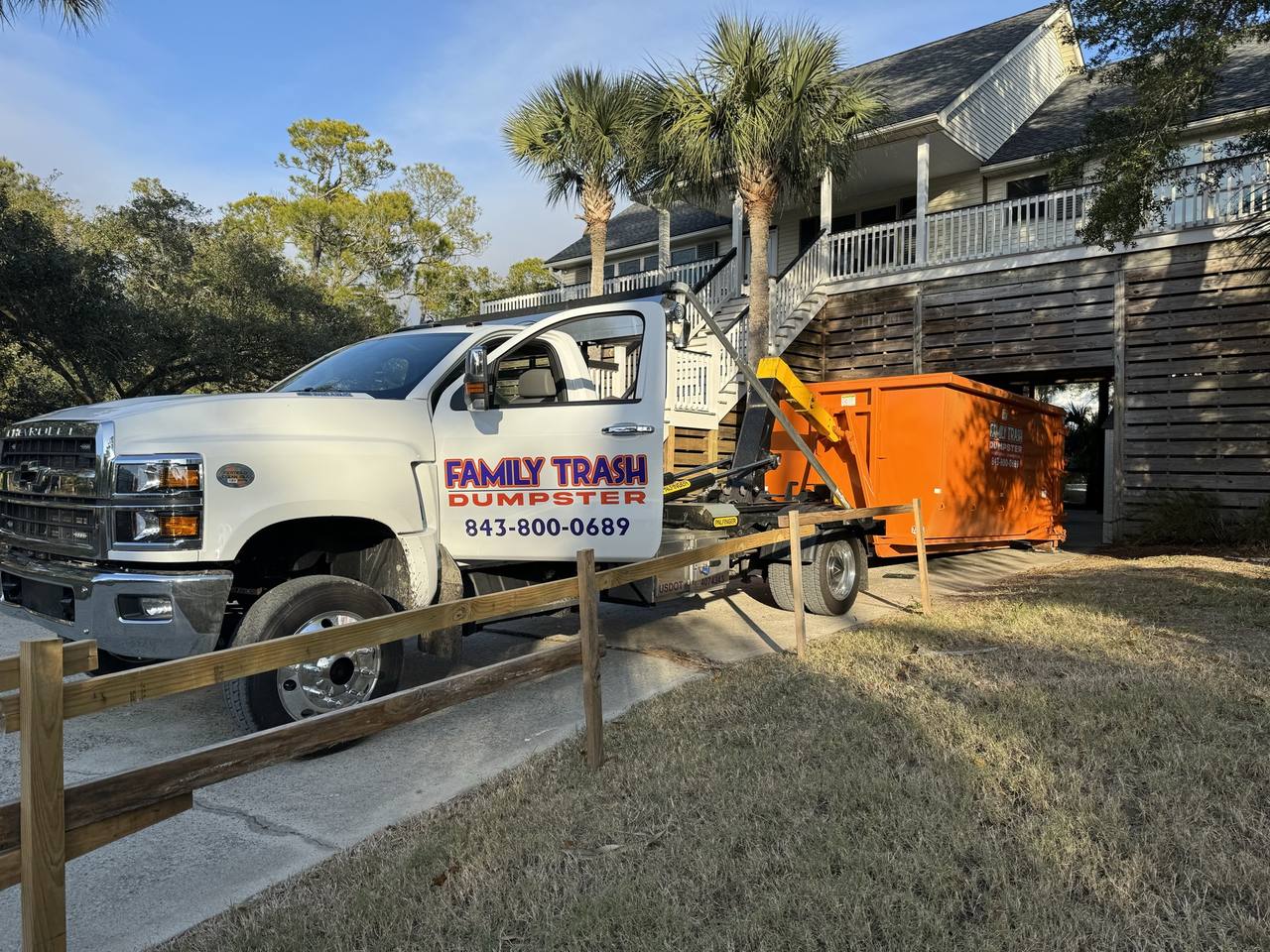
Most businesses do not think about a dumpster until they are standing in front of a load of debris with nowhere to put it. For some Charleston operations that happens once a year. For a remodeling crew it happens every job. This is the guide we point business owners and contractors to when they call and ask what they need, how big it should be, and where to put it.
Which Charleston businesses and trades need one
The answer usually comes down to the trade and what kind of waste that trade makes.
Remodelers and general contractors. If you tear out kitchens, bathrooms, or entire interiors, you already know how fast a job fills up. Cabinets, old drywall, flooring, framing lumber, and torn-out fixtures add up to more volume than weight, so that is a job for one of the bigger containers. A 22-yard handles a full gut, and on longer projects you can swap it when it fills instead of letting debris stack up out front.
Roofers. Roofing is its own category because shingles are dense. A single layer of tear-off on an average Charleston roof puts down a surprising amount of weight. Shingles go in the 7-yard only. It looks small next to a 22, and that is on purpose. A heavy-material container has to stay short so the truck can lift it and a clean load can go to the recycle plant. On a bigger roof, plan a second one rather than overloading a single container.
Concrete, masonry, and hardscape crews. Anyone breaking up driveways, sidewalks, patios, or old footings is dealing with the densest waste there is. Concrete, brick, block, and rock all go in the 7-yard for the same reason shingles do. Dirt, rock, and sod fall in the same bucket.
Landscapers and tree services. Brush, branches, and yard debris are bulky but not dense, so they go in the bigger sizes. The exception is hauling out dirt, sod, or rock as part of a regrade. Keep the two streams separate and both jobs go smoother.
Property managers and turnover cleanouts. Landlords and managers around James Island and downtown deal with cleanouts every time a tenant leaves a mess behind. Old furniture, mattresses, household junk, and whatever gets abandoned in a garage. That is light, bulky waste, which is exactly what the mid and larger sizes are built for. A 13 or 17-yard handles most single-unit turnovers.
Retail, restaurant, and office build-outs. Tenant improvements generate the same mix as a remodel: old fixtures, shelving, drywall, ceiling tile, and packaging. Light and bulky again. If the build-out runs a few weeks, keep one on site and swap it when it fills rather than scheduling a haul every few days.
Size it by what the material weighs, not the square footage
This is the part that trips people up, and it is the same rule across every trade above.
Dense material, meaning concrete, dirt, rock, brick, sod, and roofing shingles, goes in the 7-yard. Everything lighter, meaning household junk, furniture, wood, drywall, cabinets, and yard brush, goes in the 13, 17, or 22. If a job produces both, you run two containers, and that is normal rather than a sign you planned badly.
Filling a 22-yard with concrete sounds efficient until the truck cannot legally haul it. There is also a reason to keep the streams separate beyond weight: a clean load of heavy material out of the 7-yard goes to the recycle plant, while mixing wood or bagged trash into it sends the entire load to the landfill. You can compare all our dumpster sizes and match the container to your work.
Where it goes on a commercial site
Placement is the thing nobody plans until the truck shows up and there is nowhere good to drop it.
A roll-off needs more room than people expect. The truck has to line up straight, tilt the bed, and roll the container off the back, so it wants a flat run of clear space rather than a tight angle. Plan for roughly sixty feet of length to deliver and pick up, and enough width that the container is not crowding a fence or a parked car. Overhead matters just as much. Low branches, carport roofs, gutter overhangs, and power lines all get in the way when the bed lifts, so walk the truck's path and look up.
Watch the surface. Wheels and the drop can mark a soft asphalt lot, especially in a Charleston August when the blacktop gets hot. A couple of sheets of plywood laid where the wheels and the rear of the container will rest takes five minutes and saves you a scuff. If you would rather keep the lot clear, the street is an option, but check the rules first. The City of Charleston has its own requirements for a container in the public right-of-way, and the property owner pulls that permit.
Two placement details that save your crew serious time. Leave room for the swing door on the back to open, because backing the container tight against a wall costs you the walk-in access and leaves everyone heaving material over a four-foot wall. And point the open end toward the work. On a tear-off, put it under the eave you are stripping. On a gut, point the door at that side of the building. The less ground your crew covers with a wheelbarrow, the faster the day goes.
Finally, remember the spot has to work twice. The truck comes back for a container that now weighs a great deal more than it did empty. Keep vehicles off the approach and leave the same clear run you had on delivery day.
What an overflowing container says about your business
A customer pulls into your lot and the first thing they see is the container by the back fence with a lid that will not close and bags stacked beside it on the ground. They have not spoken to an employee yet and they have already decided how you run the place.
An overloaded container reads as neglect even when the rest of your operation is tight. Trash on the ground draws gulls and pests. In Charleston heat an overstuffed container starts to smell within a day, and that smell drifts toward your door and your neighbor's. If you share a strip center or an alley, your overflow becomes everyone's problem, which is how it ends up as a call to the property manager.
The reason most containers overflow is not bad luck. It is a size or a schedule that does not match the volume actually coming out of the business. A busy restaurant fills space faster than a quiet office. Pick the size that fits your flow, then stay ahead of it: break down boxes so you are not paying for air, keep bags inside the walls instead of perched on the rim, and do not let loose trash collect around the base.
Long jobs, swap-outs, and rental windows
Rentals run from a single day up to thirty. That covers a one-time cleanout and a longer project alike.
On work that outlasts one container, we swap it. We haul the full one off and set an empty in the same spot, so the crew keeps working instead of standing around. If you can see a busy stretch coming, a seasonal rush or a renovation, get the container on site before the debris starts stacking. Staying ahead of it is easier than digging out.
Delivery, pickup, and disposal are part of the rental, so once it is on site the waste side of the job is something you stop managing.
What cannot go in
A few things stay out of every container we run: batteries, wet paint, chemicals and solvents, motor oil and fuels, propane tanks, tires, and electronics. Appliances with refrigerant, so a fridge, freezer, or AC unit, need the refrigerant pulled by someone licensed first, so mention those when you book. If your business generates any of it regularly, set it aside and handle it through the proper channel rather than letting it hold up a pickup. Here is what goes in a dumpster if you want the full list before your crew starts loading.
Booking one for your business
We are family-owned, based on James Island, and we have been doing this since 2023. We cover Charleston and the towns around it, roughly a forty-mile spread, so check the towns we serve to confirm you are in range. If you want the service page rather than the guide, here is commercial dumpster rental.
Tell us the trade, the material, and the site, and we will match the container and the schedule to it before you book. Tony answers his own phone seven days a week, so call or text (843) 800-0689 and tell him what you are working on.
Common questions from business owners
Do I need a contract for a commercial dumpster?
No. Every rental is booked on its own, whether that is one container for a build-out or a standing arrangement you call in each time. You are not signing a term agreement to get a container in your lot.
Can I keep one on site permanently?
The standard window runs up to thirty days, and on ongoing work most businesses run on swaps instead: we take the full container and set an empty in the same spot. Talk to Tony about your volume and he will set up a rhythm that fits it.
What if my lot is shared with other tenants?
Then placement matters more than usual. Pick a spot that does not block another tenant's loading area or the fire lane, and check whether your lease or the property manager has rules about container placement. Tell us the constraints and we will work inside them.
Who is responsible if something banned ends up in our container?
The account holder, which is why it is worth telling your crew what stays out before the job starts. If something turns up, let us know before pickup. Pulling one item out on site is quick. Finding it at the scale can bounce the load.
Can you handle a build-out and the heavy demo on the same job?
Yes, usually with two containers. The demo material, so concrete, block, and tile beds, goes in the 7-yard, and the build-out debris goes in a 17 or 22. Running both at once is normal on commercial work and keeps the heavy load clean enough to recycle.
Need a dumpster in Charleston? Call or text Tony at (843) 800-0689, or order online.
(843) 800-0689 Get instant pricing