
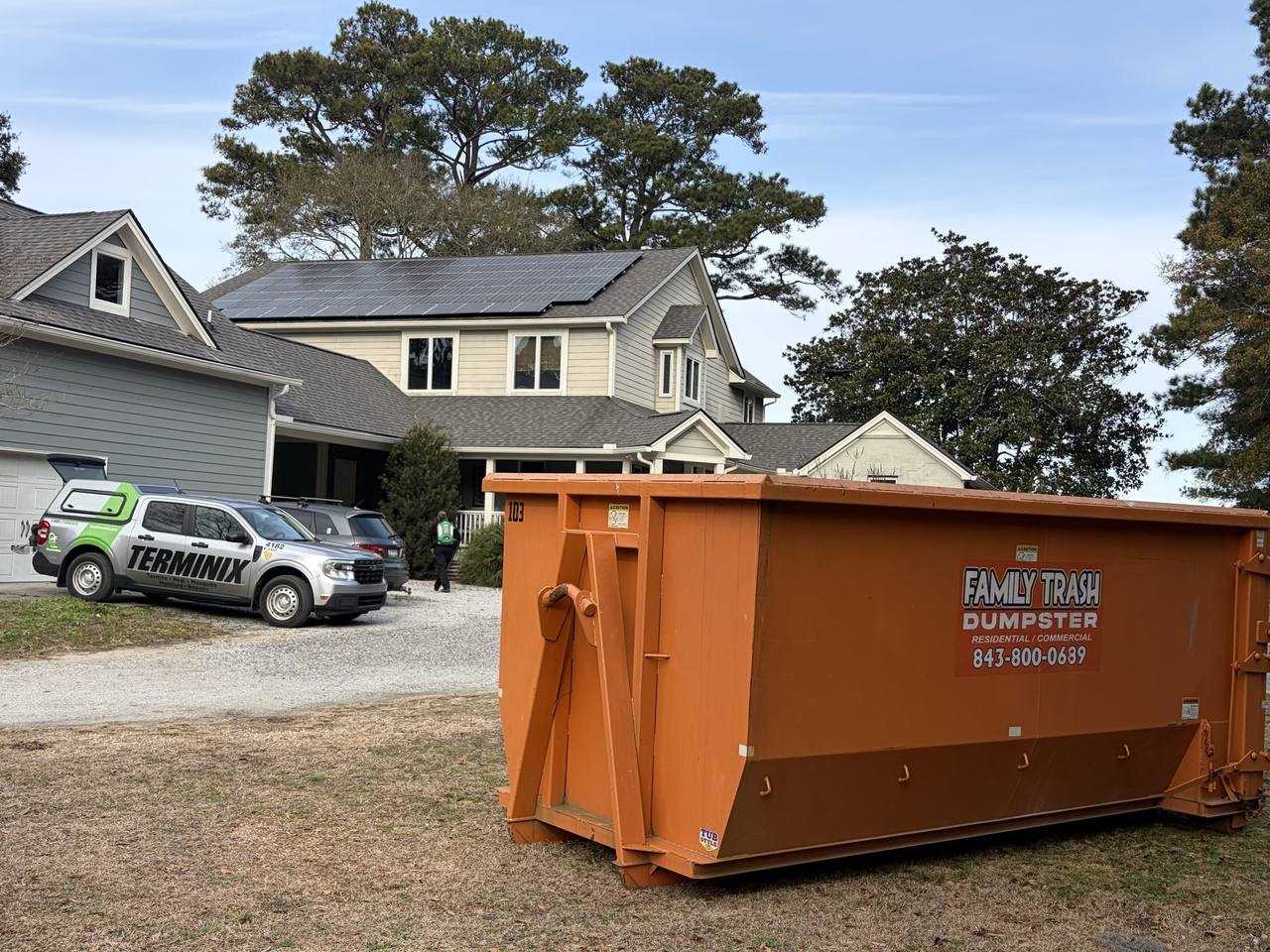
A roll-off dumpster looks bigger than it is once a crew starts throwing things in. People toss in a few cabinets, a couch, some studs at angles, and suddenly a 17-yard dumpster is full at maybe half its actual capacity. Then you're calling for a swap-out you didn't need. The cubic yards on the dumpster are the cubic yards you get, but only if the load is packed instead of piled. Here's how we tell Charleston contractors and homeowners to get every yard out of the dumpster they rented.
Break things down before they go in
Air is the enemy. A kitchen cabinet thrown in entire keeps its hollow shape and wastes the space inside it. Pull the doors, knock the box flat, and it lays down to almost nothing. Same with furniture, pallets, and big cardboard. A few minutes with a recip saw or a hammer pays off because flat material stacks and rounded or boxy material does not.
Long pieces cause the most trouble. Studs, trim, fencing, and pipe should get cut to fit the floor of the dumpster rather than laid across at an angle. One 2x4 stuck corner to corner can hold up everything stacked above it and leave a gap underneath. Cut it down and it lies flat.
Load in layers, heaviest on the bottom
Treat the dumpster like you're packing a moving truck. Build a flat first layer across the entire floor with the heavy, dense stuff, then fill the gaps with smaller debris before you start the next layer. Loose chunks falling into voids do more for your capacity than anything else.
Heavy material has its own rules, though. Concrete, dirt, rock, brick, sod, and roofing shingles only go in the 7-yard. It's the only size built for dense loads, and clean heavy material from it goes to the recycle plant. The bigger dumpsters, the 13, 17, and 22, take household junk, furniture, wood, drywall, yard brush, and remodel debris, but no heavy material mixed in. So a tear-out with both demo concrete and framing lumber usually means two dumpsters, not one overloaded one. If you're not sure which side your debris falls on, what goes in a dumpster lays it out plainly.
Fill the gaps as you go, not at the end
The mistake we see most is everyone loading fast, leaving the corners and pockets empty, and then trying to fix it once the dumpster looks full. By then the heavy stuff is already buried and you can't reach the holes. Keep a bucket of smaller debris nearby and feed it into the gaps layer by layer. Demolition rubble, broken drywall pieces, and offcuts are perfect gap-fillers.
Sweep up too. Loose nails, scrap, and broken tile that you'd otherwise leave on the ground can pour into the seams between bigger items and add up to serious volume over a full job.
Pick the size that matches the job
Loading smart starts before the dumpster ever arrives. Renting too small means swap-outs that slow you down. Renting too big means you're paying for empty air. For a single-room remodel or a garage cleanout, the 13-yard usually handles it. A full-house renovation or a roof tear-off leans toward the 17 or 22. Heavy demo points you straight at the 7-yard no matter how small the pile looks, because weight fills that dumpster long before volume does. You can compare all our dumpster sizes side by side if you're on the fence.
On longer jobs we do swap-outs, so you can run a full dumpster off the site and a fresh one in. That's often better than wrestling a bigger dumpster onto a tight Charleston lot. If you tell us the job, we'll tell you honestly which size fits.
Don't overfill the top
Filling well means filling level. Debris mounded above the rails can't be hauled safely and may have to come back off before pickup. Keep the load even with the top edge of the dumpster. If you've packed the layers tight underneath, a level fill still gives you far more than a heaped, loose one ever would.
Match the material to the right container first
No amount of clever loading fixes the wrong container.
Dense material, meaning concrete, dirt, rock, brick, sod, and roofing shingles, goes in the 7-yard, where the limit is weight rather than space. Everything lighter, meaning wood, drywall, cabinets, furniture, and brush, goes in the 13, 17, or 22, where the limit is space rather than weight.
That distinction changes how you load. In a heavy container you are managing weight distribution, so flat and low. In a light container you are fighting air pockets, so break down and stack.
Keep out what we cannot take
Nothing wastes space like re-handling a load.
Batteries, wet paint, chemicals and solvents, motor oil and fuels, propane tanks, tires, and electronics stay out of every container. Appliances with refrigerant need it pulled by someone licensed first. If one of those ends up buried under a load, someone has to dig it back out before pickup, which costs more time than sorting would have. Here is what goes in a dumpster.
Plan for the haul, not just the container
The point of loading well is fewer hauls, and a haul only happens if the truck can take it.
Keep the load level with the top rail, because anything heaped above the walls cannot legally go down the road and the driver will have to leave it. Leave the approach clear so the truck has the same straight run it had on delivery. And if the job is going to outrun one container, call for the swap at about three-quarters full rather than waiting until it is packed.
Common questions about loading a dumpster
Does it matter what order I load things in?
Yes, more than people expect. Heavy and flat on the bottom, bulky in the middle, and small fill material worked into the gaps as you go. Saving the small stuff for the end means it sits on top and you lose the space underneath it.
Can I stack debris above the rails if it is light?
No. The rule is about transport rather than weight, so even light material above the top rail stops the container from being hauled legally.
Is it worth breaking down cabinets and furniture?
It is the single highest-return thing you can do. A dresser loaded in one piece can waste several feet of container in trapped air. Broken down flat, the same piece takes a fraction of the room.
How do I know if I am about to run out of space?
Watch the halfway point against how much of the job is done. If the container is half full and the demo is a third finished, you either need a swap or you needed a bigger container, and knowing on day two beats finding out on day four.
Does a tightly packed container weigh too much to haul?
It can, but only with dense material, which is why concrete and shingles have their own container. In a 13, 17, or 22 filled with wood, drywall, and household debris, you will run out of space long before weight becomes the issue.
A few simple habits, breaking material down, layering it, and feeding the gaps, will routinely get a job done in one box that a careless load would split across two. We rent across Charleston and the towns around it, so if you want a hand sizing a job, look at the towns we serve and then call or text (843) 800-0689. Tony answers his own phone, and getting the size right the first time saves everybody a trip.
Need a dumpster in Charleston? Call or text Tony at (843) 800-0689, or order online.
(843) 800-0689 Get instant pricing