
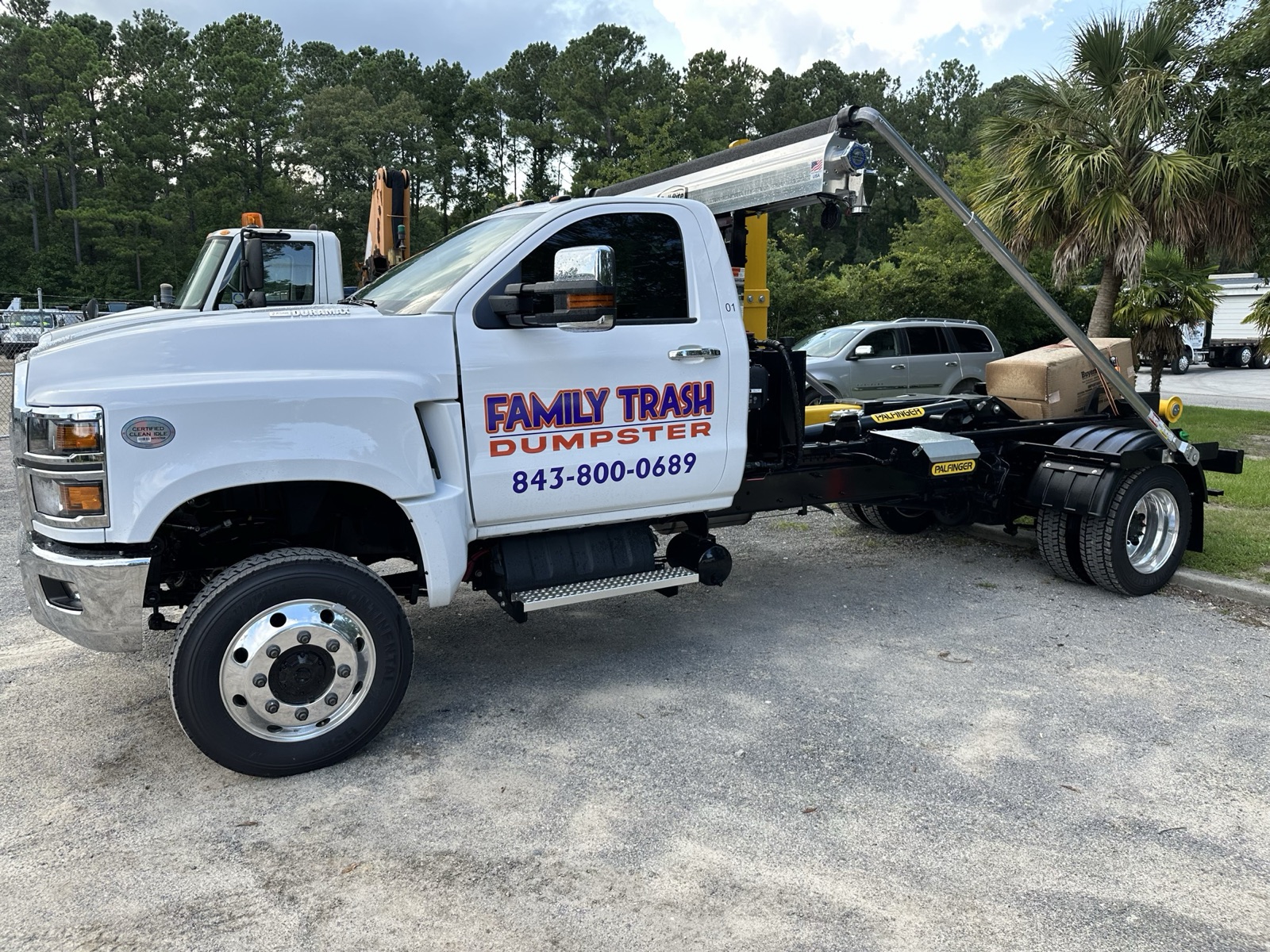
Pickup day is the part most people forget about. You load the dumpster all week, the date comes, and the truck shows up to find a car parked behind it or a load piled two feet over the rails. A few minutes of prep the night before saves you a return trip and keeps things moving. Here is what we look at when we roll up, and how you can make the swap quick.
Clear a straight path to the truck
The driver needs to back up to the dumpster and winch it onto the bed. That means a clear, straight line from the street to where the dumpster is sitting. Walk the path the night before and look for anything that gets in the way.
Move cars out of the driveway and off the apron. We see this one constantly. A truck parked behind the dumpster turns a five-minute pickup into a knock-on-the-door, wait-for-the-neighbor situation. Roll up basketball hoops, trash cans, and trailers too.
If the dumpster is on grass or a soft spot, check that the ground is still firm. After a Charleston downpour the lawn can turn to mush, and a loaded box plus a truck can sink in. If the area is soggy, give us a heads up so we can plan for it.
Look up while you are at it. Low branches and sagging cable lines can catch the truck as it lifts the dumpster. If something is hanging over the dumpster, trim it or tell us before the driver arrives.
Keep the load level and under the rails
A dumpster has to ride down the road, so the load can't be heaped over the top edge. If material is sticking up past the rails, the driver can't take it. That is a hard rule for hauling on public streets, not a preference.
Before pickup, walk around the box and knock down anything tall. Break down cardboard and bulky boxes so they lie flat. Slide longer pieces of wood or trim down along the bottom instead of letting them stand up. You want the top to sit flush or below the rim.
While you are looking, pull out anything that doesn't belong. We can't take batteries, chemicals, or electronics, and those need to come out before the truck arrives. If you are unsure about an item, check what goes in a dumpster or text a photo and ask. Sorting it now beats getting the load turned away.
This is also where size matters. If you rented the 7-yard for concrete, dirt, or shingles, keep it to that heavy material only and don't top it with light junk. If you have one of the bigger dumpsters like the 13-yard for a remodel, that one takes wood, drywall, furniture, and brush, but no heavy material mixed in. Keeping the load matched to the dumpster keeps your pickup simple.
Make sure the lid and doors are closed
Most of our boxes have a back door that swings open so you can walk debris in instead of lifting it over the side. Handy while you are loading. Not handy on pickup day if it is left hanging open.
Latch the door before the truck arrives. An open door drags on the ground when the dumpster tips onto the bed and can spill the load. Same with any lid or tarp. Pull it tight and secure it so nothing flies out on the drive to the disposal site.
Confirm the date and be reachable
We run pickups across Charleston and the the towns we serve, so the schedule moves around the area through the day. You don't have to be home when we come, but you do want your phone handy in case the driver hits a snag, like a blocked path or a gate he can't get through.
If your plans changed and you filled the dumpster faster than expected, you can ask about a swap. On bigger jobs we drop an empty and take the full one so you keep working. Just give us enough notice to fit it in.
A quick text the day before is always welcome. Let us know if anything about the site changed, the dumpster moved, a fence went up, a car will be in the way. The more we know going in, the faster we are in and out.
Time the pickup around the work, not the calendar
The best way to time a haul-off is to tie it to the job rather than to a date you picked when you booked.
A weekend garage cleanout usually ends Sunday afternoon, so that is your window. A kitchen tear-out ends when the last of the debris is out, which might be Tuesday. Rentals run from one day up to thirty, so there is room to set the pace rather than racing a clock. If the job finishes earlier than you planned, call and we will work you into the route. We will not name an exact hour, because that depends on where the trucks already are that day, but the sooner we know the job is done the sooner we can fit you in.
Getting the container gone quickly matters more than usual on a tight driveway or a busy street. Plenty of spots around James Island, West Ashley, and Mount Pleasant have no room to spare.
When you want a swap instead of a pickup
On a bigger job you often do not want the container gone. You want an empty one.
That is a swap: we haul the full container off and set a fresh one in the same spot so the work never stops. It comes up constantly on roofing tear-offs and concrete jobs, where dense material fills the 7-yard faster than people expect, and on long remodels running a 13 or larger.
The timing tip that saves the most grief: call for the swap when the container is about three-quarters full, not when it is full. Calling the day you notice it is packed means you are already behind, and your crew spends the gap stacking debris on the ground.
On a job site, a full container stops everything
On most builds the container is the choke point. Framers make scrap, drywall crews make offcuts, finish trades make packaging, and when it is full all of that has nowhere to go.
There is a safety and legal side too. Debris above the rail can blow off or slide during transport, and loose nails and sharp metal poking over the top are how somebody gets hurt reaching in. An overloaded container cannot legally go down the road either, so heaping it up delays your own haul-off. Keep it level with the top rail and the schedule holds.
If you can tell us when your big debris days are coming, we will plan the swaps around them instead of reacting to each call.
Do not let a full container sit through a storm
A container loaded with drywall, brush, or cardboard gets heavier and messier once it soaks, and rain is the one variable nobody plans for.
If your load is close to full and weather is coming, it is worth calling for the pickup before the storm rather than after.
Questions about pickup day
What do I need to do before the truck comes?
Three things. Get the load level with the top rail, move any vehicle that boxes the container in, and clear the path the truck needs to back up. That is usually all of it.
Does the load really need to be level?
Yes. A load heaped above the walls cannot be tarped or hauled legally, so the driver has to leave it. Five minutes of pushing things down beats losing your pickup slot.
Can I add one more thing after I have scheduled the pickup?
Sure, as long as it fits under the rail and it is not on the banned list. If it is a fridge or anything with refrigerant, call first.
What if my car is in the way and I am not home?
The driver cannot move it, so the pickup does not happen. If you are going to be out, park somewhere else the night before and leave the approach open.
Do you pick up on weekends?
We run seven days a week. If your job wraps on a Saturday, it is worth locking the pickup in earlier that week so the slot is already set.
If you are not sure your box is ready, or you want to line up a swap or a pickup time, call or text (843) 800-0689. You can also look at all our dumpster sizes if you are planning the next project while this one wraps up.
Need a dumpster in Charleston? Call or text Tony at (843) 800-0689, or order online.
(843) 800-0689 Get instant pricing