
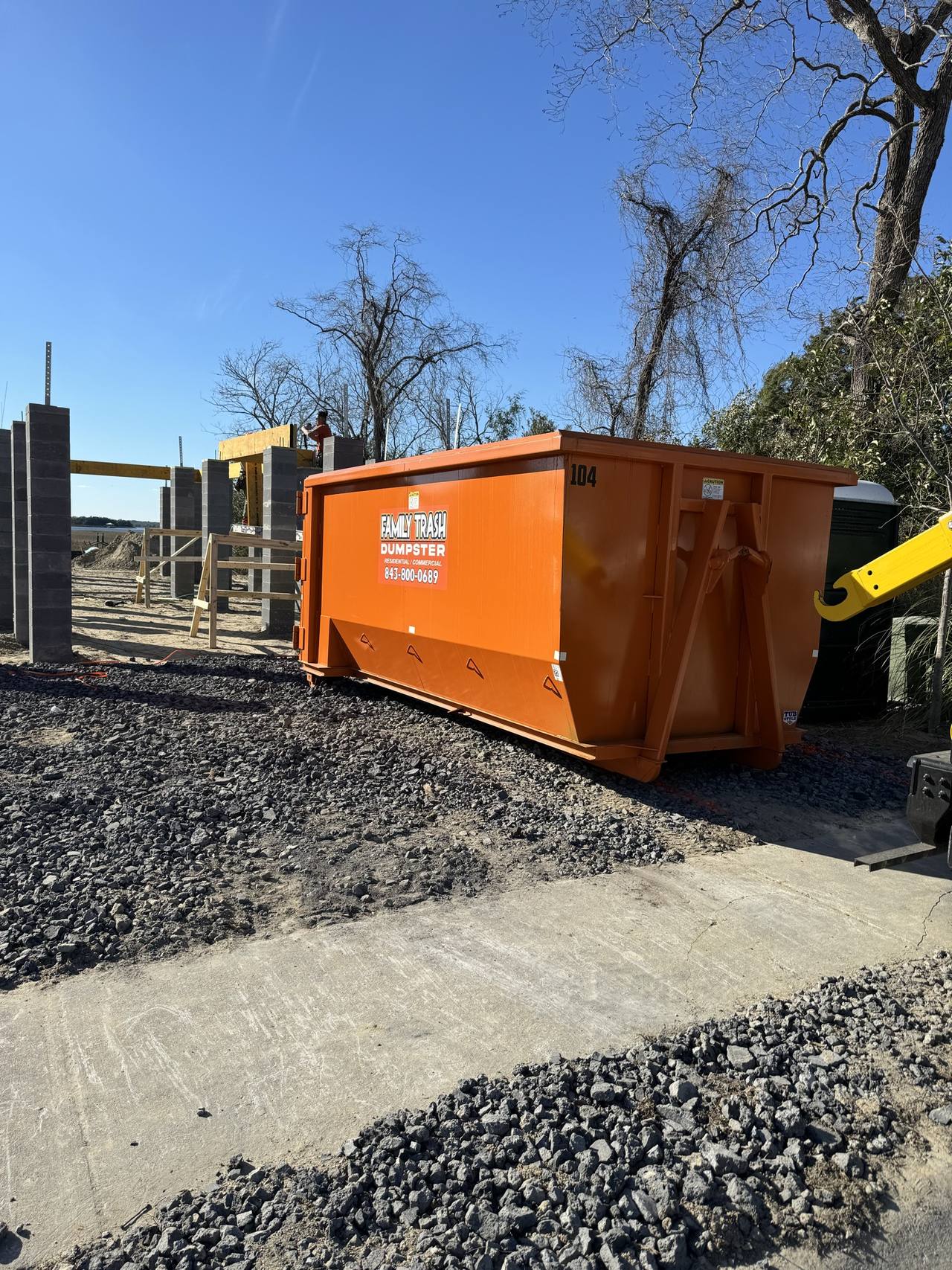
Almost every call we get starts the same way. Somebody describes a project, then asks which size they need. It is the right question, and the answer is less about how big your house is than about what you are throwing away.
Here is how we work it out, and how you can work it out yourself before you book.
Start with the material, not the volume
The first thing to sort out is not how much debris you have. It is how heavy that debris is.
Dense material, meaning concrete, dirt, rock, brick, sod, and roofing shingles, goes in the 7-yard and nothing else. That container stays short on purpose, because weight fills it long before volume does. A taller container packed with concrete cannot be lifted or legally hauled, so a bigger size is not an upgrade for that material. It is a container we cannot pick up.
Everything lighter, meaning household junk, furniture, mattresses, wood, drywall, cabinets, flooring, and yard brush, goes in the 13, 17, or 22. Those sizes are built for bulk rather than weight, which is why they stand taller.
If your project produces both, you run two containers. That is normal on a remodel where a tile shower bed or an old chimney comes out alongside the cabinets, and it is worth doing: a clean load of heavy material out of the 7-yard goes to the recycle plant, while mixing wood or bagged trash into it sends the entire load to the landfill instead.
A quick read on each size
7-yard. The heavy-material container. Concrete, dirt, rock, brick, sod, and shingles. A patio demo, a small slab, a load of soil, a roof tear-off. On a larger roof, plan a second one rather than overloading a single container.
13-yard. The one most Charleston homeowners end up with. A single-room remodel, a garage, a bathroom gut, a good-sized cleanout. It holds a lot without swallowing the entire driveway.
17-yard. The step up when the job is bigger than one room but not a full gut. A kitchen and a bathroom running at the same time, flooring pulled across several rooms, a larger cleanout with furniture.
22-yard. A full interior gut, new construction scrap, a commercial clear-out, or a house being emptied completely. Bulky and light is what it is for.
Flatbed. For loads that do not suit a walled container: long lumber, bulky metal, equipment, anything easier to set on than to lift over a wall.
You can compare all our dumpster sizes side by side, and if you want the sizing tool rather than the guide, here is what size dumpster do I need.
Matching the size to common Charleston jobs
A garage or attic cleanout usually fits the 13. Household junk is bulky rather than heavy, so you run out of room before you run out of weight. Break furniture down and stack flat and it holds more than people expect.
A kitchen remodel is a 13 for most single-kitchen jobs once cabinets, counters, flooring, and drywall come out. Add a bathroom in the same stretch and move to the 17.
A roof tear-off is the 7-yard, every time, regardless of how the shingles look stacked on the ground.
A full-house cleanout or an estate is a 17 or a 22, depending on how much furniture is going and whether the attic has been touched in the last decade.
Yard work and storm debris go in the bigger sizes, because brush and limbs are bulky and light. The exception is when a regrade sends dirt, sod, or rock out with it. That part goes in the 7-yard.
A concrete or hardscape tear-out is the 7-yard, and clean loads from it get recycled.
When to size up, and when not to
If you are between two sizes and the job is messy, go up. The gap in price between one size and the next is smaller than the cost of renting twice, and nobody has ever regretted having a little room left over. That is the general rule.
The one place it does not apply is weight. Sizing up does not help with concrete, dirt, or shingles, because the limit there is what the truck can lift rather than how much space you have. For heavy material the answer is a second 7-yard, not a taller container.
Where you are matters too
Space shapes the answer as much as the debris does. A 22-yard needs room to land level and a straight run for the truck, which downtown lots and some of the older streets on the peninsula simply do not have. The smaller footprint of the 7 or the 13 tucks into a tight spot better.
Think about overhead as well. Low branches, carport roofs, and power lines all get in the way when the truck lifts the bed. If the spot is tight, describe it when you book and we will tell you what fits before a truck is on the way rather than after.
Still not sure? Describe the job
The fastest way through this is to say what you are tearing out and let us match it. Tony answers his own phone seven days a week, so call or text (843) 800-0689, tell him the project, and he will point you at the right size before you commit to anything.
We are family-owned, based on James Island, and we cover Charleston plus the towns around it. Check the towns we serve to confirm you are in range, and here is what goes in a dumpster if you want the loading rules before you start.
Common questions about dumpster sizes
What if I pick the wrong size?
Call before delivery and we will change it. If it is already on the ground and clearly too small, we would rather swap it early than have you cram it and stall out halfway through the job.
How many pickup truck loads is a 13-yard?
Roughly forty. One yard is about three truck loads, which is the math that makes most people stop hauling it themselves once they add up the fuel, the scale fees, and the weekend.
Do you have a 15-yard?
No, and most companies advertising one are describing something close to our 13 or 17. The number on the side matters less than whether the container suits the weight of your material.
Can I put a little concrete in a bigger container?
It is not worth it. Even a small amount of heavy material in a 22 changes what the truck is lifting, and mixing it in costs you the recycling on the clean load. Keep the two streams separate and run a 7-yard alongside.
Does a full container weigh enough to damage my driveway?
Rarely, but it is worth a thought on a soft asphalt drive in a Charleston August. A couple of sheets of plywood laid where the wheels and the rear of the container rest takes five minutes and avoids a scuff.
Need a dumpster in Charleston? Call or text Tony at (843) 800-0689, or order online.
(843) 800-0689 Get instant pricing