
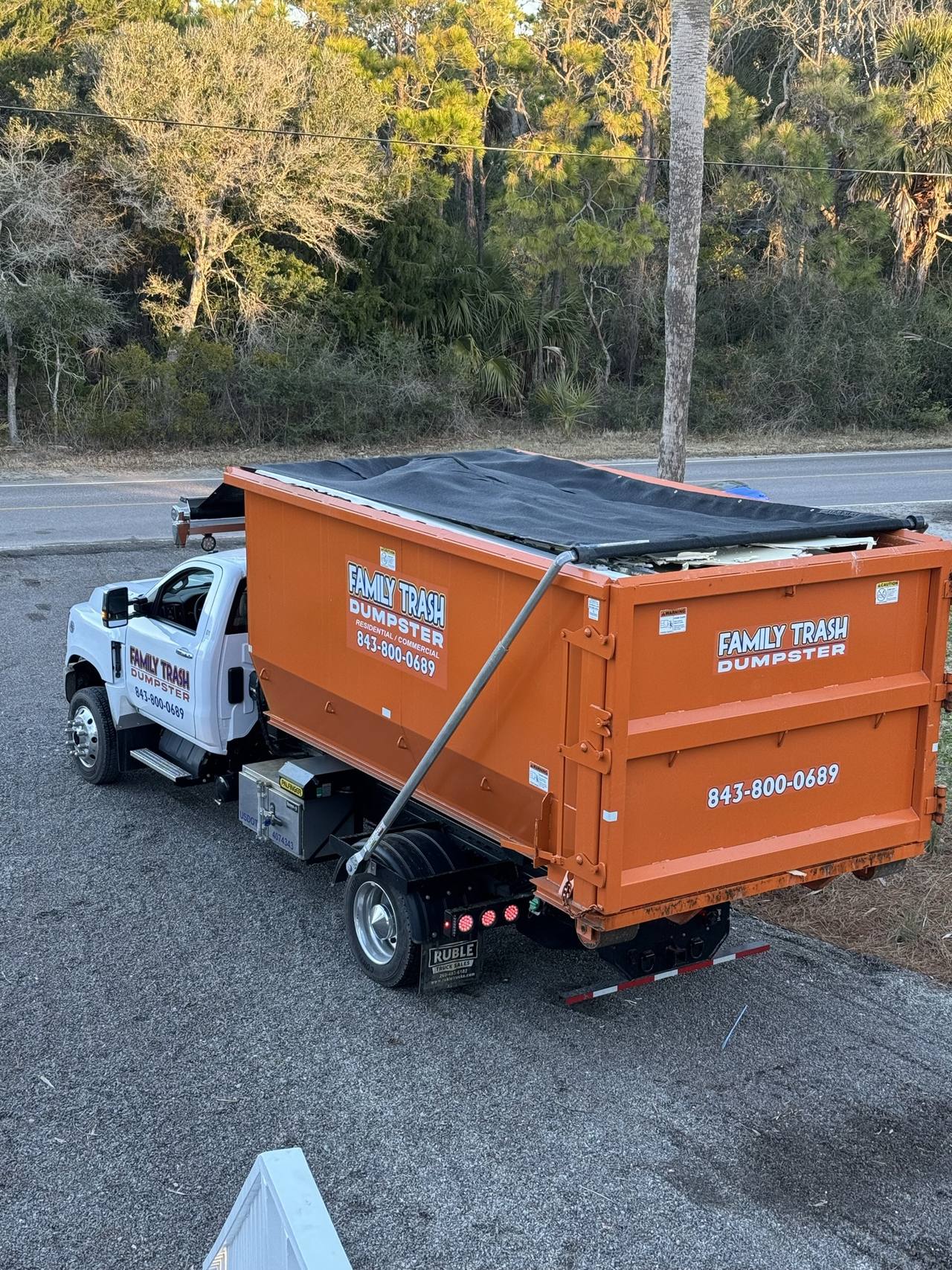
Every business that generates debris ends up choosing between two rhythms. Either a container lives on your property and gets swapped on a schedule, or you order one when a job calls for it and send it away when the job is done. Both work. Picking the wrong one either leaves you paying for empty steel or scrambling for a container in the middle of your busiest week.
Here is how we help Charleston businesses decide.
Start by knowing what you actually throw away
Before the schedule question, answer the volume question, because the schedule follows from it.
Spend a week paying attention to what leaves your building. Is it bagged trash and broken-down boxes, or is it construction debris from work you do off site? Does it come out steadily every day, or does it arrive in a wave when a project wraps? A shop that fills two bags a day has a completely different problem from a contractor whose debris shows up all at once on demo day.
The businesses that get this wrong usually guessed at their volume instead of watching it. A week of paying attention beats a year of ordering the wrong size.
What on-demand actually means with us
On-demand is the simpler of the two. You call, we drop a container, you fill it, we pick it up. Rentals run from a single day up to thirty, so it stretches to fit the job rather than a billing cycle.
This suits project work. A build-out, a remodel, a turnover cleanout, a seasonal clear-out. The debris has a beginning and an end, so the container should too. It also suits businesses whose messy weeks are rare enough that a standing container would sit half empty most of the year.
When a standing setup makes more sense
If debris comes out steadily rather than in waves, keeping a container on site and swapping it is less work for you.
The swap is the mechanism worth understanding. We haul the full container off and set an empty one in the same spot, so there is no gap where your crew is stacking material on the ground waiting for a truck. On a long remodel or an ongoing operation, that is the difference between a job that keeps moving and one that stalls every time the container fills.
You are not signing a term contract to do this. It is the same rental, repeated at a rhythm that matches your volume.
Time the drop to the messy phase, not the start date
This is the scheduling mistake that costs the most, and it applies either way you go.
A container that lands on day one of a four-week job sits empty through demo prep and framing layout, then fills in three days when the tear-out actually happens. Work out which phase produces the debris and put the container there. On a remodel that is demo. On a build-out it is usually the last week, when packaging and offcuts pile up at once.
The same logic runs at the other end. Build the pickup into your closeout rather than remembering it three days later, when you are paying for a container full of nothing but air.
Build a rhythm for recurring work
If you do the same kind of job over and over, you already know roughly how much debris one produces. Use it.
A property manager who turns over units knows a single-unit cleanout fits a 13 or a 17. A roofer knows a tear-off means the 7-yard and probably a second one on a big roof. Once you know your own numbers, ordering stops being a guess and the schedule builds itself. Tell us the pattern and we can plan around your calendar instead of reacting to each call.
Pick the size before you pick the schedule
Neither rhythm saves you if the container is wrong for the material.
Dense material, so concrete, dirt, rock, brick, sod, and roofing shingles, goes in the 7-yard. Everything lighter, so household junk, furniture, wood, drywall, and yard brush, goes in the 13, 17, or 22. Get this backwards and the schedule question is irrelevant, because a 22-yard packed with concrete cannot be hauled at all. Compare all our dumpster sizes first, then decide how often you need it.
Keep the wrong stuff out so pickup does not slip
Nothing derails a schedule like a container that cannot be picked up.
Batteries, wet paint, chemicals and solvents, motor oil and fuels, propane tanks, tires, and electronics stay out of every container we run. Appliances with refrigerant need it pulled by someone licensed first. Loads also have to sit level with the top rail, because anything heaped above the walls cannot be tarped or hauled legally. If your crew loads it, tell them both rules once at the start rather than discovering the problem on pickup day. Here is what goes in a dumpster.
A simple way to decide
If your debris arrives in projects, order per job. If it arrives every week, keep one on site and swap it. If you are somewhere in between, start on-demand and watch how often you are calling. When you find yourself ordering every couple of weeks, a standing rhythm is probably cheaper in time even where it is similar in money.
We are family-owned, based on James Island, and we cover Charleston plus the towns around it. Check the towns we serve, or go straight to commercial dumpster rental if you already know what you need. If you would rather talk it through, call or text (843) 800-0689 and Tony will tell you which rhythm fits the volume you are actually producing.
Common questions about scheduling
How far ahead do I need to schedule a swap?
Call when the container is getting close rather than after it is already overflowing, and we can usually work it into the route without much fuss. On a job with a predictable rhythm, tell us the pattern once and we can plan around it.
Am I charged differently for a standing arrangement?
Each swap is priced as its own rental, so you are paying per container rather than for a subscription. Ask when you book and you will get the number before anything is delivered.
What happens if my job runs past thirty days?
We keep working with you. Thirty days is the standard window rather than a hard stop, and long jobs run on swaps anyway, which resets the clock each time.
Can I switch sizes partway through a job?
Yes. If demo turns out heavier than expected, or a build-out produces more bulk than you figured, the next swap can be a different size. That is easier than cramming the wrong container.
Is it cheaper to keep a small container and swap it often?
Usually not. Each swap is a truck trip, so a container that fits your volume beats a smaller one you empty twice as often. The exception is heavy material, where the 7-yard is the only option regardless of how often you fill it.
Need a dumpster in Charleston? Call or text Tony at (843) 800-0689, or order online.
(843) 800-0689 Get instant pricing