
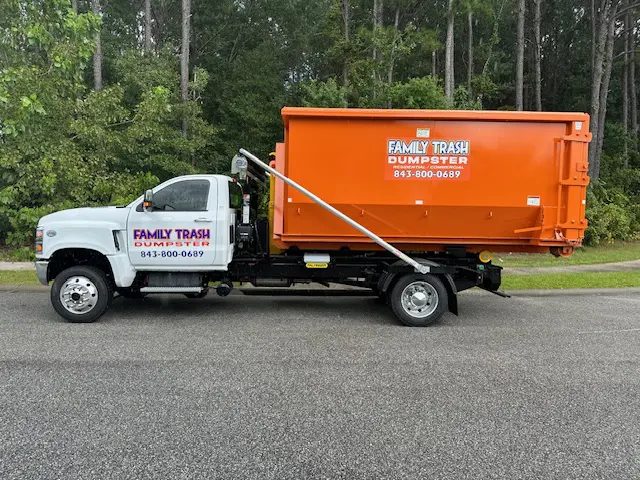
Gutting a bathroom is one of those jobs that looks small and then fills a debris pile faster than you expect. The room might only be five by eight feet, but once you start pulling tile, plaster, and an old cast-iron tub, the weight adds up quick. Here on James Island and around Charleston, I get a lot of calls from folks who are doing the demo themselves and want the right dumpster sitting in the driveway before they swing the first hammer. Here's how I'd think about it.
What Comes Out of a Bathroom
A full bathroom gut is more material than people guess. You've got wall and floor tile, the mortar bed or backer board behind it, drywall or old plaster, a vanity, the toilet, a medicine cabinet, and the tub with its surround. If the house is older, you might be pulling lath and plaster instead of drywall, and that stuff is dense.
The tricky part is that bathroom debris splits into two very different piles. The drywall, wood trim, the vanity cabinet, and the tub are bulky but fairly light. The tile, mortar, plaster, and any concrete under the floor are heavy. That split is what decides which dumpster you actually need.
Why the 7-Yard Is Often the Right Call
Most people see a small room and reach for a small container, or they assume bulky stuff means they need a big one. With a bathroom, the deciding factor is usually weight, not volume.
Tile and plaster are heavy and dense. A pile that barely covers the floor of a big dumpster can still be a serious load. That's why for the heavy demo material, the 7-yard is the one I send out. It sits lower to the ground, which makes it easier to toss broken tile and chunks of mortar over the side, and it's rated for heavy, dense material. Concrete, dirt, rock, sod, brick, and roofing all go in the 7-yard too, so if your bathroom job has a mortar bed or a concrete subfloor, that's your container.
The bigger sizes, the 13-yard and up, are built for volume, not weight. They take household junk, furniture, wood, drywall, and yard brush, but not heavy material like tile and mortar. So if you tried to load an entire tile demo into a big dumpster, you'd be putting heavy debris in a container that isn't meant for it.
Splitting the Job
For a lot of bathroom remodels, the cleanest approach is to think about your debris in two groups. Put the heavy stuff, the tile, mortar, and plaster, in the 7-yard. If you've also got a pile of lighter remodeling debris from the rest of the house, drywall, old cabinets, framing scraps, that lighter material can go in a 13-yard or larger.
If you're not sure how your specific job breaks down, call me and we'll talk it through. A single bathroom usually fits in one 7-yard for the heavy material. Bigger remodels where you're gutting more than one room are where swap-outs come in handy. You fill it, I pull it and bring an empty, and you keep working.
You can see all the options on the page for our dumpster sizes if you want to compare before you call.
Watch the Weight, Not the Volume
This is the one mistake I see most with DIY demo. Folks load a big dumpster two-thirds full of tile and think they have room to spare, when really they've already packed in about all the weight that load should carry. Heavy material fills weight before it fills space.
With the 7-yard you don't have to do that math in your head as much. It's low, it's rated for the heavy stuff, and you can load it without worrying that a few hundred pounds of tile is going to be a problem.
A few things that don't go in any of my dumpsters: batteries, chemicals, and electronics. If your bathroom demo turns up an old water heater or some leftover paint and solvents, set those aside and handle them separately.
Protect the Tub-Out Path
One last bit of advice that has nothing to do with the dumpster and everything to do with saving your floors. Before you pull the old tub, plan how you're getting it out of the house. A cast-iron tub is heavy and awkward, and dragging it across a hallway or down stairs will gouge whatever's in its way.
Lay down cardboard or moving blankets along the path from the bathroom to the door. Clear the route first so you're not trying to steer a tub around furniture. If you've got a second set of hands, use them. The same goes for hauling buckets of tile and mortar out to the dumpster, a clear and protected path keeps the rest of the house from taking damage during demo.
When you're ready to get a container in the driveway, give me a call at (843) 800-0689. We're family-owned, based right here on James Island, and we serve Charleston plus the surrounding towns. If you want to check that we reach your spot, here are the towns we serve. I answer my own phone seven days a week, so give me a call and we'll get you set up.
Need a dumpster in Charleston? Call or text Tony at (843) 800-0689, or order online.
(843) 800-0689 Get instant pricing