
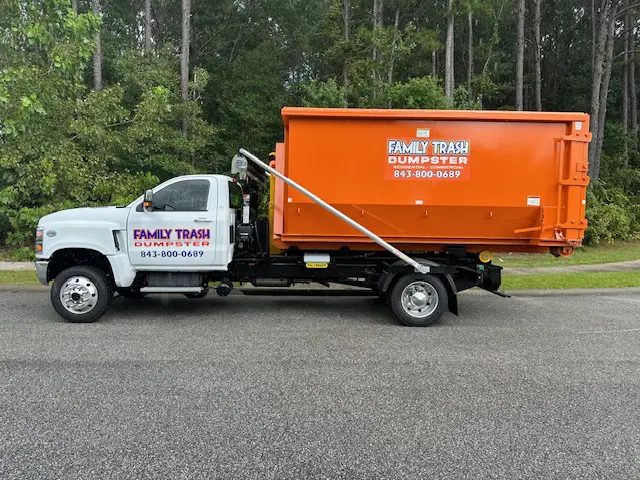
If you've ever driven past a remodel or a new build in Charleston and seen a big open-top metal container sitting in the driveway, that's a roll off dumpster. The name comes from how it works. A truck rolls it off the back of the bed onto the ground, leaves it with you for the job, then comes back and rolls it on again to haul it away. No moving parts on your end, no pile of debris sitting in your yard for weeks.
People rent them for all kinds of work. A kitchen tear-out, a roof, a garage that finally needs to be emptied, a deck rebuild, a move where half the house is going to the curb. The container shows up, you fill it on your own time, and we come get it. That's the entire arrangement.
How a roll off actually works
A roll off truck has a long bed with rails and a hydraulic system. When it backs up to your spot, the bed tilts and the dumpster slides down the rails to the ground on its own wheels. That's the "roll off" part. Pickup is the same thing in reverse. The truck winches the loaded container back up onto the bed.
Because they load and unload this way, roll offs need a clear straight shot. A driveway, a flat patch of yard, or a spot on the street usually works fine. We need room for the truck to back in and enough overhead clearance, so no low branches or power lines right over the drop spot. If you're not sure your spot will work, call or text and describe it. We've delivered all over James Island, downtown, and the outlying towns, so we've seen most setups.
Once it's on the ground it stays put for the length of your rental. Rentals run anywhere from one day to a month, and on bigger projects we'll swap a full one for an empty one so you can keep going.
Open top, and why that matters
A roll off is open on top, unlike the closed compactor dumpsters you see behind a restaurant. Open top is what makes it useful for a project. You can walk wheelbarrows up to it, toss in drywall and old cabinets, or have a roofer drop shingles straight off the roof. The trade-off is that what goes in has to follow some rules.
Weight is the big one. Heavy, dense material packs a lot of pounds into a small space, so it doesn't go in the same container as light bulky junk. We handle that by matching the size to the load, which I'll get to next. A few things can't go in any roll off at all: batteries, chemicals, and electronics. Those need their own disposal. You can see the full breakdown on what goes in a dumpster.
Picking a size
We run four sizes, plus a flatbed for hauling equipment or materials. The thing most people get wrong is assuming bigger is always better. For heavy material it's the opposite.
The 7-yard is the only size we put heavy, dense debris in. That means concrete, dirt, rock, sod, brick, and roofing shingles. It's smaller on purpose, because that kind of material gets heavy fast and a clean load of it heads to the recycle plant rather than the landfill.
The bigger containers, starting with the 13-yard and going up from there, are for the lighter stuff. Household cleanouts, furniture, wood, drywall, yard brush, and general remodeling debris. They give you a lot of volume for bulky items that don't weigh much per cubic foot. What they don't take is the heavy material above. If you're mixing a remodel with a few chunks of old patio concrete, give us a call and we'll sort out whether that's one container or two.
If you're stuck between sizes, it's an easy conversation. Tell us what the job is and roughly how much there is, and we'll point you to the right one. You can also look over all our dumpster sizes and see the dimensions side by side.
What's included when you rent one
When you rent a roll off from us, the delivery, the pickup, and the disposal at the end are all part of it. You don't arrange the haul-off separately or chase down a landfill. We drop it, you load it, we take it and deal with where it goes.
One thing worth being clear on: we rent the dumpster, we don't load it for you. The container is yours for the rental and you fill it at your own pace. That's what keeps it simple and keeps you in control of your timeline.
We're family-owned, started here in 2023, and we cover Charleston plus about 16 nearby towns inside roughly a 40-mile range. If you want to check whether you're in the area, here are the towns we serve. We're licensed, insured, and reachable seven days a week. When you call, you usually get Tony.
What a front-load dumpster is
A front-load dumpster is the metal can with the sloped lid that lives behind a restaurant, an apartment complex, or a shopping center. It has sleeves on the sides. The garbage truck pulls up, slides forks into those sleeves, lifts the entire container up over the cab, and dumps it into the truck. Then it sets it back down.
Front-loads are made for ongoing waste. The dumpster stays put permanently and a truck comes by on a set schedule, once or twice a week, to empty it. They are sized in cubic yards too, usually smaller than a roll-off, because they are getting emptied so often. A business that produces trash every single day uses one of these. A homeowner doing a one-time cleanout has no use for it.
Roll-off or front-load: which one you need
The short test is whether your waste has an end date. A project, a cleanout, a remodel, a tear-off produces a burst of debris and then stops, which is a roll-off. A business producing trash every day on an ongoing basis is a front-load.
We run roll-offs. If what you actually need is a permanent can emptied on a weekly schedule, that is a different service and we will tell you so rather than renting you the wrong thing.
Common questions about how a roll-off works
Why is it called a roll-off?
Because of how it arrives. The truck tilts its bed and the container rolls off the back on wheels, then rolls back on for pickup. That is also why it needs a straight run of clear space rather than a tight angle.
How much room does the truck need?
Plan for roughly sixty feet of clear length and enough width that the container is not crowding a fence or a parked car. Overhead matters just as much, since low branches, carport roofs, and power lines get in the way when the bed lifts.
Does it have a door, or do I have to lift everything over the side?
There is a swing door on the back, and using it is the difference between walking material in and heaving it over a four-foot wall. Leave room for that door to open when you pick the spot.
How is it different from the dumpster behind a restaurant?
That is a front-load, which stays put permanently and gets emptied on a route by a truck that lifts it over the cab. A roll-off comes to you for a project and leaves when the project is done.
What comes with the rental?
Delivery, pickup, and disposal. You get the container for your window, you load it, and we handle where it goes. There is no separate dump run or scale fee to chase.
So if you've got a project coming up and you're not sure where the debris is going to go, that's the gap a roll off fills. Call or text (843) 800-0689 and tell us what you're working on, and we'll get the right container in your driveway.
Need a dumpster in Charleston? Call or text Tony at (843) 800-0689, or order online.
(843) 800-0689 Get instant pricing